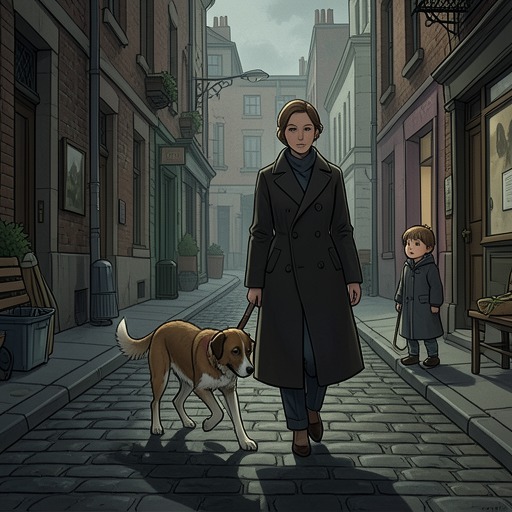
Beagles
También esto pasaráBeagles are bred at Tom’s country property, a place that also gathers and shelters dogs. Their presence turns a family stop on the way to Cadaqués into more than a visit to see puppies: Blanca and the children encounter a crowded animal refuge, the force of dogs at play, and the fragility of newborn life. For Blanca, whose journey is shadowed by her mother’s death, the visit also briefly opens the possibility of bringing a dog into the family and naming it in her mother’s memory.
The refuge and its keeper
Tom lives in a dilapidated house on an immense tract of land, where he collects dogs and breeds Beagles. His connection to the family comes through Sofía: they were partners when young and remained friends after their relationship ended. When Sofía later wanted a child, she asked Tom to father one. He agreed to give Daniel his surname and see him occasionally, while making clear that Sofía would be the child’s sole parent; he already had two daughters for whom he was actively responsible. Their arrangement explains why Tom’s property becomes a stop on the family’s journey, while keeping his role in Daniel’s life distinct from the daily parenting Sofía undertakes.
The visit also sketches Tom as someone whose life is organized around animals rather than domestic polish. A dusty sign at the entrance marks the place as Villa Beagle. When Tom appears, he has dressed hastily and wears torn trousers; he laughs when Sofía points out that they expose his backside. The portrait that follows presents him as direct, decisive, and fond of animals, women, poker, and marijuana. Sofía says that he has a large cannabis plantation beyond the dogs’ land and that it helps support the animal refuge. The Beagles are thus part of a working, improvised rural world: breeding, sheltering, and the practical business of sustaining the dogs occupy the same landscape.
The pack in the field
Before lunch, the family approaches the property along a long, quiet dirt track. When nobody answers the bell, the children climb the fence and call for Tom. Barking sounds in the distance, and a pack of dogs of different ages, breeds, and conditions comes running toward them. Two young men emerge behind the animals, calling them by name and playing with them. They open the gate, and the dogs greet the visitors with jumps, licks, and occasional barks, which the young men promptly quiet.
The children, initially hesitant at the sight of so many dogs together, soon race across the field, laughing and shouting as the dogs follow. Blanca lingers with an older, scruffy animal that stays at her side instead of joining the movement. She describes the encounter as a wordless recognition: the dog approaches, accepts her touch, and nudges her leg whenever she withdraws her hand, asking for more. The narrative does not identify this particular dog as a Beagle. Its importance lies instead in the contrast it creates within the pack scene: while the children are swept into collective play, one tired animal establishes a quieter, individual connection with Blanca.
Blanca reflects on the pleasure of seeing domesticated dogs run in the sun, ears flying and tails moving, enjoying a freedom that she contrasts with the confinement of apartment life. The dogs’ exhilaration becomes a direct, physical image of being alive without explanation or qualification. This response is not presented as a description of Beagles alone; it arises from the whole pack. But the Beagle-breeding property provides the setting in which that sight becomes possible, placing animals’ energetic presence alongside the more managed routines of breeding and refuge.
Puppies and the thought of adoption
Tom arrives, and the group goes to see the puppies before lunch. They cross a field of fig and olive trees to a long, low building divided into small enclosures. Older puppies occupy some outdoor pens, where they jump and run about when they hear the visitors. The newborns are kept in cooler, dimmer interior spaces, apart from the bustle of the older dogs. The arrangement makes the visit move from the open-field commotion to a more sheltered encounter with birth and early dependence.
The children register the exhaustion of the mothers and the vulnerability of the newborn puppies, which are blind and described as ugly as hairless mice. They stop at the threshold, unwilling to enter, and ask Blanca to take home one of the older puppies. Faced with the request, she imagines adopting a female and naming her after her mother. She immediately doubts the idea, attributing it to having smoked marijuana on an empty stomach, and tells the children to ask the Three Kings instead. No puppy is adopted in the scene. The brief proposal nonetheless gives the Beagles a personal significance beyond their appeal as animals to visit: they become the possible focus of a new attachment and a gesture of remembrance.
A journey interrupted by grief
The stop at Tom’s property comes during a drive toward Cadaqués, a road associated for Blanca with journeys taken with her mother. She experiences the detour from that route as an unexpected relief, because death seems to have driven her out of places bound to those shared trips. At the same time, the refuge’s puppies bring her close to the beginnings of life. The contrast is not resolved by an adoption or a declaration; it remains suspended in her passing thought of a dog named after her mother and in the children’s appeal to the Three Kings.
After seeing the puppies, the group goes to lunch at a modest roadside hotel. Later, while the children and Úrsula swim and the adults drink coffee on the terrace, Tom mentions an important upcoming poker tournament. Blanca recalls that her mother loved poker, and Tom responds by inviting her to come. The exchange does not change the dogs’ place in the scene, but it extends the visit’s association with Blanca’s mother: the property has offered both a possible new companion and an occasion to remember an aspect of the person she has lost. The Beagles therefore belong to a landscape of care and activity, while the visit’s emotional meaning remains shaped by bereavement, memory, and the uncertain prospect of taking another animal home.